

Here are well-known historic public mystics—figures whose mystical lives were visible, voiced, and influential in the public sphere, often through visions, prophecies, writings, or reform. I’ll group them by type and briefly note why each is considered public rather than hidden.
I’ll keep the focus on Christian history, since that’s where your earlier questions have been centered.
I. Great Catholic public mystics (classical canon)
1. Hildegard of Bingen (1098–1179)
Type: Visionary–prophetic
Why public:
- Recorded detailed visions from childhood
- Wrote Scivias and other visionary works
- Preached publicly (rare for a woman at the time)
- Corresponded boldly with popes and emperors
She explicitly understood her visions as mandated to be proclaimed.
2. Catherine of Siena (1347–1380)
Type: Prophetic, visionary, political
Why public:
- Claimed direct instruction from Christ
- Publicly admonished church leaders
- Instrumental in urging the pope to return to Rome
- Dictated mystical dialogues for circulation
Deeply obedient — but unmistakably public.
3. Teresa of Ávila (1515–1582)
Type: Visionary, reformer, teacher
Why public:
- Reported visions, locutions, ecstasies
- Authored detailed mystical manuals
- Reformed the Carmelite order
Important nuance:
She was forced into publicity by obedience — but her mystical descriptions made her public.
4. John of the Cross (1542–1591)
Type: Apophatic, poetic, dark-night mystic
Why public (qualified):
- Public through poetry and doctrine
- His suffering and imprisonment were public
- Less visionary, but his teaching became normative
He’s a borderline case: inwardly hidden, outwardly public.
II. Medieval & early modern public visionaries
5. Julian of Norwich (1342–c.1416)
Type: Visionary theologian
Why public:
- Recorded a series of revelations in detail
- Her text circulated widely
- Spoke with theological authority grounded in visions
She lived as a recluse, yet her mysticism was publicly mediated through writing.
6. Bridget of Sweden (1303–1373)
Type: Visionary, prophetic
Why public:
- Claimed ongoing revelations from Christ and Mary
- Addressed kings, popes, and nations
- Her Revelations circulated widely and controversially
7. Meister Eckhart (c.1260–1328)
Type: Apophatic preacher
Why public:
- Preached mystical theology publicly
- Addressed lay audiences
- Later investigated for doctrinal errors
Public teaching, not visions, made him public.
III. Early modern to modern public mystics
8. Joan of Arc (1412–1431)
Type: Auditory–prophetic
Why public:
- Claimed direct voices from saints
- Acted on them politically and militarily
- Trial records preserve her mystical claims verbatim
Few mystics were more publicly exposed.
9. Padre Pio (1887–1968)
Type: Charismatic, stigmatic
Why public:
- Visible stigmata
- Mass public devotion
- Massive pilgrimages
Not self-seeking, but unavoidably public.
V. Why these are “public” in the technical sense
They share at least one of the following:
- Recorded visions or voices
- Public proclamation of divine messages
- Written revelation texts
- Direct influence on church or society
- Discernment conducted in public view
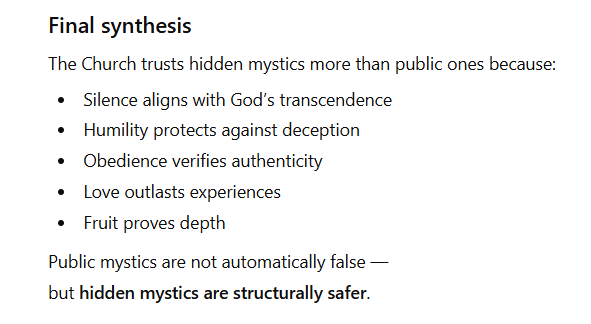
One-sentence synthesis
Public mystics mediate God through content.
Hidden mystics mediate God through absence.
Both have shaped Christianity — but in very different ways.
If you want, next I can:
- Rank these figures by degree of publicity
- Contrast public mystics who were later affirmed vs. rejected
- Or map them onto the types of mysticism we discussed earlier

This is a crucial question, Michael — because most mystical experience in Christian history actually happens to lay people, not monks or clergy. The tradition has always known this, even if it hasn’t always said it plainly.
Here’s how Christianity understands lay people who have mystical experiences, without romanticizing or dismissing them.
1. First principle: mystical experience ≠ vocation to be a “mystic”
For lay people especially, the Church makes a sharp distinction between:
- having mystical experiences
- being called to a public mystical role
Most lay people with genuine experiences are not called to teach, publish, or proclaim them.
The experience may be real
the calling may be hidden
This is where confusion often arises.
2. Historically, many mystics were lay (or began as lay)
Examples:
- Catherine of Siena — lay Dominican
- Julian of Norwich — not a nun
- Angela of Foligno — wife and mother before becoming a tertiary
- Simone Weil — never baptized, profoundly mystical
- George Fox — lay visionary
So lay status is not a barrier — but it shapes discernment.
3. How the Church interprets mystical experiences in lay people
Classically, the Church asks three questions, in this order:
(1) What is the fruit?
Not:
- How intense?
- How frequent?
- How strange?
But:
- Greater humility?
- Greater charity?
- Greater patience?
- Greater groundedness in ordinary life?
For lay people, family life, work, and relationships are the testing ground.
(2) What is the posture toward the experience?
Healthy posture looks like:
- Curiosity without fixation
- Gratitude without attachment
- Willingness to let it go
Unhealthy posture looks like:
- “Why did this stop?”
- “What does this make me?”
- “What does this mean about my importance?”
The tradition watches this very closely.
(3) Does it integrate — or isolate?
Authentic lay mysticism:
- Integrates with community
- Does not demand special exemption
- Does not fracture relationships
Isolation is a warning sign, not a verdict.
4. The Church’s default assumption (important)
When a lay person reports visions, dreams, or synchronicities, the Church’s starting assumption is not:
“This is divine”
nor:
“This is pathological”
It is:
“This is spiritually neutral until fruit is seen.”
Time — not analysis — is the primary discerner.
5. What the Church actually encourages lay people to do
Traditionally:
- Do not seek repetition
- Do not build identity around it
- Do not interpret it alone
- Do not suppress it anxiously
- Return to ordinary faithfulness
This is very close to John of the Cross’s advice — but gentler in practice.
6. Why lay experiences are often intermittent
Lay life includes:
- Distraction
- Responsibility
- Embodied stress
- Emotional complexity
So experiences tend to be:
- Sporadic
- Context-dependent
- Non-linear
This is not a defect — it’s normal.
7. Hidden mysticism is the norm for lay people
For most lay people with genuine mystical moments:
- The experience is for them, not for others
- It deepens trust, not authority
- It leaves no visible trace except quiet change
They may never have another one — and still be spiritually deep.
8. A very important caution (said calmly)
The tradition insists on psychological sobriety:
- Mystical experience does not override:
- Mental health care
- Medication
- Therapy
- Ordinary discernment
Grace does not bypass nature.
This protects lay people from unnecessary spiritual pressure.
9. One-sentence synthesis
For lay people, mystical experience is usually a gift, not a task;
a grace, not a role; a deepening, not a platform.
10. Why this matters in light of your earlier questions
Given what you’ve asked across this conversation:
- intermittent experiences
- concern for discernment
- interest in apophatic tradition
You’re asking the right kind of question — not “what am I?” but “how should this be held?”
That posture already aligns with hidden, lay mysticism, whether or not experiences continue.
If you’d like, next I can:
- Walk through practical discernment steps for lay people
- Show how apophatic prayer stabilizes intermittent experiences
- Or explain when it’s wise to talk about experiences — and when not to

This is one of the wisest discernment questions a person can ask, Michael — and Christian tradition answers it with great restraint, especially for lay people.
I’ll give you clear principles, not vague pieties.
1. When it is wise to talk about mystical experiences
A. In confidential spiritual direction
This is the primary context.
Wise to speak when:
- You need help interpreting posture, not meaning
- You want accountability, not validation
- You’re willing to hear: “Let this go”
The tradition assumes:
Experiences are for discernment, not circulation.
B. When the experience is troubling or destabilizing
Speak when:
- It causes fear, confusion, or anxiety
- It disrupts sleep, work, or relationships
- You feel compelled or pressured by it
Silence here is not humility — it’s avoidance.
Talking protects psychological and spiritual health.
C. When humility and charity require clarity
Rare, but real.
For example:
- A confessor needs to know context
- A therapist needs to understand inner imagery
- A trusted spouse notices changes and asks honestly
Even then:
- Keep it factual
- Avoid interpretation
- Avoid spiritual language inflation
D. When explicitly asked by legitimate authority
Historically:
- Teresa of Ávila wrote because she was ordered
- Julian wrote because others requested it
Obedience, not initiative, governs speech.
2. When it is not wise to talk about experiences
A. When you want reassurance, meaning, or identity
If the impulse is:
- “What does this make me?”
- “Was this special?”
- “Does this mean I’m progressing?”
Silence is the wiser teacher.
Talking here tends to crystallize ego around experience.
B. In casual or devotional settings
Do not share:
- In prayer groups
- In casual church conversations
- In online forums
Why?
- Experiences shape expectations in others
- Comparison and projection begin immediately
- You unintentionally become an authority
The tradition is very firm about this.
C. When the experience has passed
John of the Cross is blunt:
What is past belongs to God alone.
Revisiting experiences:
- Revives attachment
- Reinforces memory over transformation
- Distracts from present faithfulness
If it’s over, let it be over.
D. When silence produces peace
This is an underrated criterion.
If not speaking brings:
- Calm
- Humility
- Ordinary groundedness
That is often discernment itself.
3. A simple interior test before speaking
Ask yourself:
“If no one ever knows this happened,
will I still be content?”
- If yes → you may speak if needed
- If no → silence is almost certainly wiser
4. What “talking wisely” actually looks like
When you do speak:
- Describe what happened, not what it means
- Avoid theological conclusions
- Avoid dramatic language
- Avoid timelines of progress
- Accept alternative interpretations
This keeps the experience lightly held.
5. Why silence is often the higher path
Silence:
- Lets the experience die into love
- Prevents narrative-building
- Keeps God central, not the self
Most authentic experiences fade best in silence.
6. One-sentence rule of thumb
Speak for discernment or safety;
be silent for meaning or identity.
7. Final reassurance (important)
Not talking about experiences:
- Does not repress them
- Does not deny their value
- Does not make you less spiritual
It often makes the experience more fruitful.
If you’d like, I can next:
- Help you distinguish healthy silence vs. unhealthy suppression
- Offer a short discernment checklist
- Or show how the apophatic path gently absorbs experiences without conflict
Full text below soundtrack…
_____
Here’s the full text…
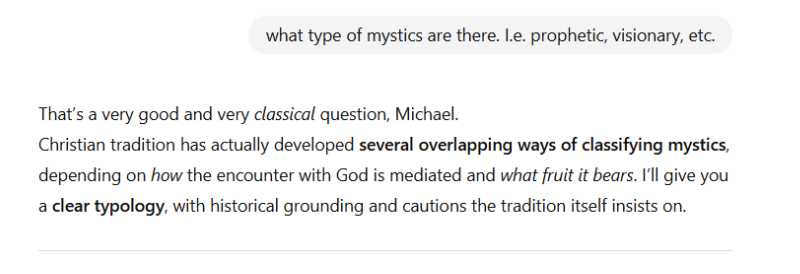
That’s a very good and very classical question, Michael.
Christian tradition has actually developed several overlapping ways of classifying mystics, depending on how the encounter with God is mediated and what fruit it bears. I’ll give you a clear typology, with historical grounding and cautions the tradition itself insists on.
I. By mode of experience (how God is encountered)
1. Visionary mystics
Mode: Images, apparitions, symbolic scenes
Examples:
- Teresa of Ávila (some visions)
- Julian of Norwich
- Catherine of Siena
Features:
- Visions may be corporeal, imaginative, or intellectual
- Often symbolic rather than literal
- Church treats visions as non-essential
Traditional caution:
Visions are the lowest and most fallible form of mystical knowledge
(John of the Cross)
2. Auditory mystics
Mode: Inner or (rarely) exterior locutions
Examples:
- Joan of Arc
- Francis of Assisi
Features:
- Words received interiorly
- Requires strict discernment
- Often paired with obedience and testing
3. Affective / devotional mystics
Mode: Intense love, sorrow, sweetness, compunction
Examples:
- Bernard of Clairvaux
- Bonaventure
Features:
- Strong emotions directed toward God
- Often centered on Christ’s humanity
- Can include tears, rapture, longing
Caution: Emotional intensity ≠ depth
4. Apophatic (negative / silent) mystics
Mode: Darkness, unknowing, silence, loss of images
Examples:
- Pseudo-Dionysius
- Meister Eckhart
- John of the Cross
- The Cloud of Unknowing
Features:
- God known by unknowing
- Absence rather than presence
- Most highly valued in classical theology
5. Unitive (nondual) mystics
Mode: Awareness of union with God beyond subject/object
Examples:
- John of the Cross (spiritual marriage)
- Teresa of Ávila (7th mansion)
- Meister Eckhart
Features:
- Not emotional or visionary
- Marked by simplicity and stability
- Often hard to describe without paradox
II. By function or vocation (what the mystic is for)
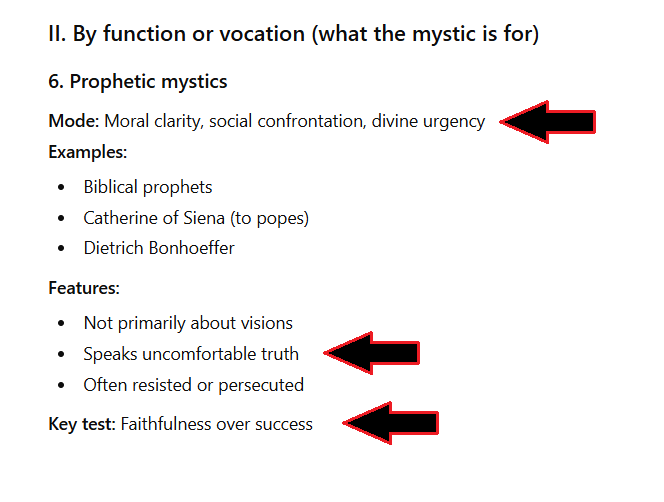
6. Prophetic mystics
Mode: Moral clarity, social confrontation, divine urgency
Examples:
- Biblical prophets
- Catherine of Siena (to popes)
- Dietrich Bonhoeffer
Features:
- Not primarily about visions
- Speaks uncomfortable truth
- Often resisted or persecuted
Key test: Faithfulness over success
7. Intercessory mystics
Mode: Hidden prayer, suffering offered for others
Examples:
- Thérèse of Lisieux
- Many cloistered religious
Features:
- No public role
- Deep identification with others’ pain
- Often unknown in their lifetime
8. Ascetical / purgative mystics
Mode: Discipline, detachment, purification
Examples:
- Desert Fathers and Mothers
Features:
- Focus on ego dismantling
- Long preparation stage
- Not yet unitive, but foundational
III. By psychological expression (how it appears outwardly)
9. Ecstatic mystics
Mode: Rapture, bodily effects, trances
Examples:
- Teresa of Ávila (occasionally)
Caution:
Ecstasy is incidental, not proof of holiness
10. Dry / dark mystics
Mode: Absence, doubt, interior poverty
Examples:
- John of the Cross
- Mother Teresa
Features:
- Often mistaken for loss of faith
- Actually a deepening beyond consolation
IV. By tradition and theology
11. Christocentric mystics
- Focus on Jesus’ life, wounds, passion
- Very common in Western Christianity
12. Trinitarian mystics
- Experience articulated through Father, Son, Spirit
- Less emotional, more structural
13. Pneumatological mystics
- Emphasis on Spirit, breath, fire, movement
- Often overlaps with charismatic Christianity
A crucial unifying principle (this matters)
The same person may be several types at once.
Example:
- Teresa of Ávila = visionary + affective + unitive + reformer
- John of the Cross = apophatic + dark-night + unitive
- Catherine of Siena = prophetic + visionary + intercessory
The Church never classifies a mystic by phenomena alone.
Classical hierarchy (often surprising)
In traditional Christian theology, from lowest to highest reliability:
- Visions and locutions
- Emotions and sweetness
- Moral transformation
- Silence, humility, charity
- Stable union beyond images
Final word (especially given your earlier questions)
Christian mysticism is not about having experiences
It is about becoming transparent to God
Experiences may:
- Appear
- Disappear
- Never appear at all
Yet transformation continues.
If you’d like, next I can:
- Help you discern where prophetic vs visionary lines blur
- Compare Christian vs Jewish mystical typologies
- Or map these types onto psychological categories without reducing them
Just say the word.