Note: Listen to the video below while reading this piece–it adds dimension…
_____

Yes—music has historically been understood to trigger, deepen, or accompany mystical experience in Christian mysticism, though with important theological cautions.
Christian mystics across centuries describe music as a secondary instrument that can dispose the soul toward contemplation, not as the source of grace itself.
1. Biblical and early Christian foundations
Music is already linked to altered spiritual states in Scripture:
- 1 Samuel 16:23 – David’s harp soothes Saul’s tormented spirit
- 2 Kings 3:15 – Elisha calls for a musician, and “the hand of the Lord came upon him”
- Psalms – repeatedly associate music with entering God’s presence
Early Christians inherited the Jewish belief that sound and harmony align the soul with divine order.
2. Church Fathers: music as spiritual medicine
St. Augustine
Augustine famously struggled with music’s power:
“I am inclined to approve of the custom of singing in church… yet when I find the singing itself more moving than the truth it conveys, I confess myself to have sinned.”
(Confessions, Book X)
- Music opens the heart, softens resistance, and awakens longing
- But it can also seduce the senses if not disciplined by prayer
This ambivalence becomes a permanent feature of Christian mystical theology.
3. Medieval mystics and ecstatic music
Hildegard of Bingen (12th c.)
- Composed soaring liturgical music she said was revealed to her in visions
- Taught that music restores the harmony lost at the Fall
- Saw chant as a bridge between heaven and earth
Francis of Assisi
- Frequently sang spontaneously in ecstatic joy
- Music accompanied states of rapture and union
Meister Eckhart
- Warned that sensory sweetness (including music) must eventually be transcended
- But accepted that it can prepare the soul for detachment
4. Apophatic (negative) mysticism: music as ladder, not destination
In the apophatic tradition (Pseudo‑Dionysius, John of the Cross, The Cloud of Unknowing):
- Music is useful early on
- Eventually it must fall away into silence
St. John of the Cross
- Appreciated sacred music
- Warned against mistaking emotional elevation for divine union
- True union occurs in darkness, stillness, and unknowing
Thus:
Music may open the door, but God is encountered beyond sound.
5. Gregorian chant and contemplative states
Gregorian chant was explicitly designed to:
- Slow breathing
- Reduce discursive thought
- Induce recollection (inner gathering)
Monastics reported:
- Heightened awareness
- Sense of timelessness
- Occasional visions or deep peace during chant
Modern neuroscience confirms chant can shift brain rhythms toward theta and alpha states, which correlate with contemplative absorption—but Christian theology insists grace is not reducible to physiology.
6. Discernment: the Church’s caution
Christian tradition consistently teaches:
Music can:
- Dispose the soul toward God
- Trigger tears, compunction, longing
- Accompany authentic mystical grace
But it can also:
- Create false consolation
- Intensify imagination rather than contemplation
- Be confused with the Holy Spirit
Hence the insistence on:
- Humility
- Moral fruits (charity, patience, obedience)
- Spiritual direction
7. In summary
Yes—music can trigger or accompany mystical experiences in Christian mystics, but:
- It is a means, not the cause
- It prepares the soul, but God acts freely
- The deepest mystical states move from sound → silence
Or as many mystics imply:
Music awakens the soul to listen—
but God speaks in the stillness that follows.
If you’d like, Michael, I can also:
- Compare this with Jewish or Sufi understandings of sacred music
- Explain how discernment distinguishes mystical grace from aesthetic rapture
- Relate this specifically to apophatic “pulses” or waves along the contemplative path

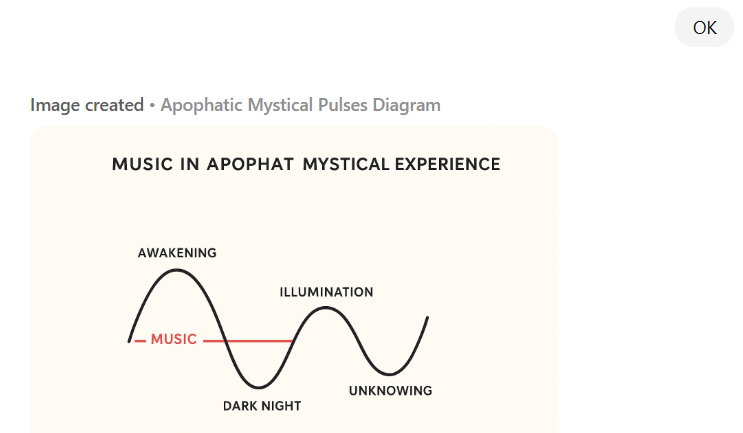
Absolutely, Michael. Let’s connect music with the apophatic mystical framework, specifically the idea of “pulses” or waves” along the contemplative path. This is subtle, so I’ll go step by step.
1. Apophatic mysticism and the “wave” model
In apophatic (negative) mysticism, the spiritual journey is often described as pulsed, cyclical, or wave-like, rather than linear:
- Initial awakening / desire for God – the soul is stirred.
- Purification / “dark night of the senses” – previous consolations fade; a sense of emptiness or silence dominates.
- Illumination / intermittent grace – brief flashes of clarity, vision, or union.
- Union / unknowing – a more stable but often quiet state of intimate contact with God.
These stages are not continuous—they come in waves or pulses, sometimes years apart, often with alternating consolation and desolation. St. John of the Cross and Pseudo-Dionysius describe this as the ebb and flow of spiritual life, a rhythm of ascent and purgation.
2. Where music fits
Music can be seen as a trigger or amplifier of these pulses, particularly in the early and intermediate stages:
- Preparation / initial pulse:
- Music (chant, hymns, or sacred melody) awakens the soul to God.
- This aligns with the first wave of longing or desire—an emotional stirring that prepares the intellect and will.
- Intermediate pulses / illumination:
- During moments of contemplative insight, music may intensify the awareness of divine presence.
- Mystics report that sacred melodies can make time feel suspended, which mirrors the temporal distortion often noted in mystical pulses.
- Caution in later pulses:
- Advanced apophatic stages emphasize detachment from all sensory stimuli, including music.
- Music is not the “source” of union but can temporarily coincide with the wave, providing a kind of scaffold for the soul to enter silence.
Think of music as a “crest” in the wave—it can lift the soul toward God, but the true mystical encounter happens in the underlying silent trough, where God is beyond all form, sound, or thought.
3. Examples from mystics
- Hildegard of Bingen – early to intermediate waves: music accompanies visions and moral insights.
- John of the Cross – late waves: recommends passing beyond music into the dark night of the spirit; consolations may appear as brief flashes during silence.
- Meister Eckhart – music may awaken longing (pulse), but the deeper encounter requires release into unknowing.
4. Physiological / experiential correlation
Modern research on meditation and chant supports this wave-like model:
- Music can trigger theta and alpha brain waves, associated with absorption and receptivity.
- But advanced contemplatives often train the mind to sustain awareness without external triggers, corresponding to later apophatic waves.
✅ Summary
- In apophatic mysticism, the contemplative path is pulsed or wave-like, alternating between consolation and darkness.
- Music can coincide with, amplify, or trigger these pulses, especially in the early to intermediate stages.
- True mystical union occurs beyond music, in silence and unknowing, but music can prepare the soul to ride the wave.
If you want, Michael, I can draw a simple diagram showing the waves of mystical pulses and where music typically interacts, which makes this much more visual and intuitive. Do you want me to do that?