
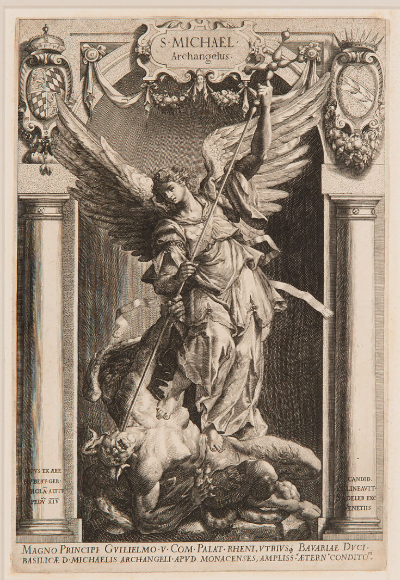
Listen to this soundtrack as you’re reading the description of intense, Catholic mystical states…
_____
In Catholic theology, ecstatic union (also called ecstasy, rapture, or extraordinary mystical union) is considered extremely rare — much rarer than the ordinary paths of holiness and prayer that most saints follow.
Here’s the best way to understand its rarity within the Church’s own teaching:
1️⃣ Only a tiny fraction of Catholics are mystics
Even among devout Catholics who reach advanced contemplative prayer, most never experience bodily ecstasy.
St. John of the Cross (doctor of mysticism) says:
- Infused contemplation is already rare.
- Ecstatic phenomena occur in far fewer cases.
2️⃣ Even among canonized saints, it’s still rare
Many canonized saints were:
- Deeply holy
- United to God interiorly
…yet never had public ecstasies.
The Church actually prefers hidden mysticism because it’s less likely to mislead or draw attention to the person rather than God.
Some saints who did have ecstatic union:
- St. Teresa of Ávila
- St. John of the Cross
- St. Catherine of Siena
- St. Padre Pio
- St. Joseph of Cupertino (levitation during ecstasy)
These are often mystical giants across centuries — not the norm.
3️⃣ Extraordinary phenomena are not the goal
The Catechism and the mystical doctors repeat:
Ecstasy is not a measure of holiness.
The real measure is:
- Charity
- Humility
- Obedience
- Virtue
Most saints grow without visions or raptures.
4️⃣ If we put numbers to it
These aren’t official Church statistics, but theologians loosely estimate:
| Group | % experiencing ecstatic union |
|---|---|
| All Catholics | far less than 0.01% |
| Serious contemplatives | a few percent |
| Canonized saints | perhaps 10–20% |
So: exceptionally rare, even among the rare.
5️⃣ Why rare?
Classical theology teaches God only gives ecstasies when:
- The soul needs strong purification
- Or when an extraordinary sign is needed for the Church
- Or when the person’s natural faculties are too strong and need to be “dislodged” for union
St. Teresa said if God can sanctify a soul without ecstasy,
He prefers the ordinary way.
Short answer
➡️ Ecstatic union is one of the rarest forms of Catholic mystical experience — even saints and advanced contemplatives usually never receive it.
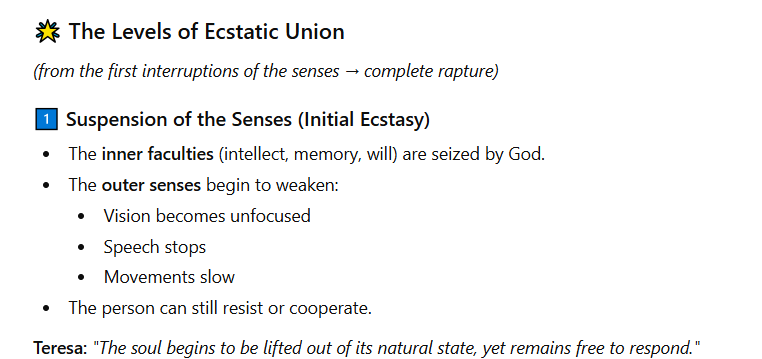
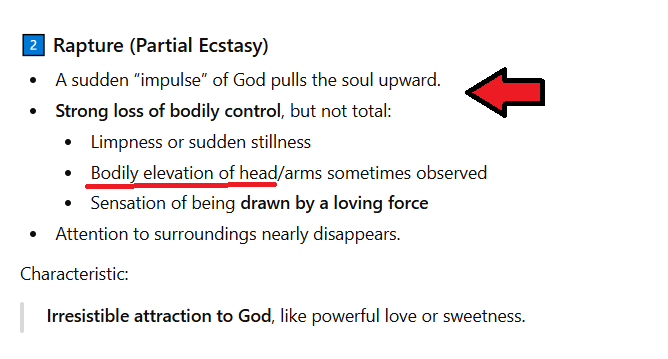
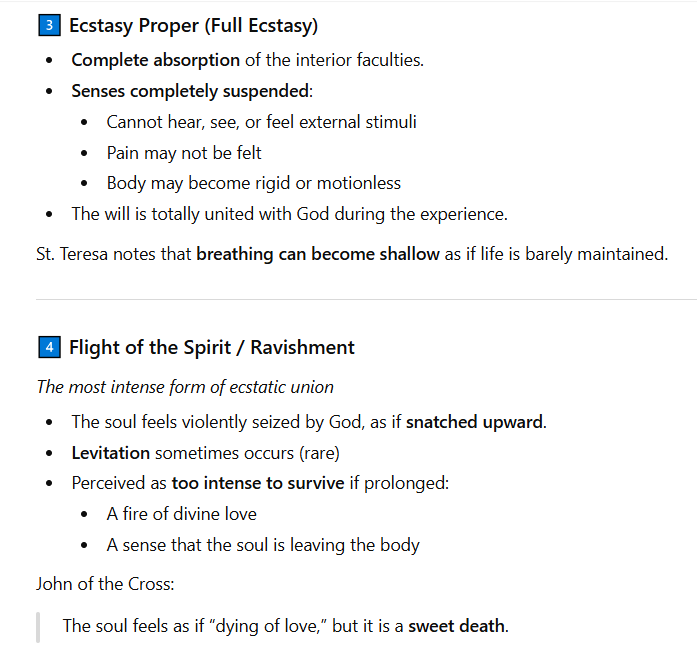

Short answer: There are no widely officially authenticated living Catholics recognized by the Church as having true ecstatic union in the same way saints like St. Teresa of Ávila or St. Padre Pio did. Today’s Church treats claims of ecstasies with very strict discernment, and it normally waits until after a person’s life is complete before making any definitive judgment about supernatural mystical experiences. USCCB
Here’s a clearer breakdown:
📌 1. Official Church Recognition Usually Happens Posthumously
The Catholic Church generally waits until after death — and often years later — before confirming that someone’s extraordinary spiritual experiences were authentic and supernatural. This is why many mystics known historically were only recognized as saints long after they died. USCCB
Because of this cautious approach:
- There might be people today who have private mystical experiences, but the Church typically will not publicly declare them authentic while they are still alive.
- Even when bishops investigate reported mystical phenomena, the outcome may be a “nihil obstat” (no objection) rather than a declaration that the experience is definitively supernatural. USCCB
📌 2. Some Contemporary Cases Are Under Investigation
There are individuals whose causes for sainthood involve reported mystical experiences (visions, ecstasies, etc.), but these cases are modern, ongoing, and not officially authenticated yet:
🔹 Servant of God Cora Evans
- An American Catholic laywoman (1904–1957) whose cause for canonization was opened.
- She reported visions of Jesus and the saints and a mystical mission.
- Her cause is currently being handled by the Diocese of Monterey, though no official Church declaration has authenticated her mystical experiences as supernatural. Wikipedia
Though Cora Evans is a candidate for sanctity, she is not formally confirmed as a living mystic today — and in any case she has already died.
📌 3. Living People Often Remain Private — and Discernment Is Cautious
Many Catholics believe there may be private mystics or contemplatives today whose prayer lives are deep and spiritual, and who might have interior experiences with God. However:
- The Church distinguishes ordinary deep prayer and interior consolation from extraordinary ecstatic union.
- Extraordinary phenomena like ecstasy, levitation, or prolonged trance are rare and always examined with extreme caution.
- The Church’s discernment norms (recently updated) emphasize that even if a phenomenon is spiritually positive or encourages devotion, it may receive only a neutral or pastoral judgment rather than a statement it is of divine origin. USCCB
In practice:
➡️ Many people may report interior graces or deep contemplative experiences today, but these are treated privately and soberly.
➡️ There’s no current publicly authenticated list of living Catholics the Church recognizes as ecstatic mystics in the way historical saints are.
📌 4. Some Contemporary Private Reports Exist — But Without Official Church Endorsement
There are frequent anecdotal reports among Catholics — people on forums, parish groups, or local communities who say they’ve had deep spiritual experiences. But:
- These reports are not verified or endorsed by the Church.
- Many such experiences are emotional, psychological, or have natural explanations unless proven otherwise through formal investigation.
This is why the Church urges believers to seek discernment through spiritual directors and clergy, not social media or unchecked claims. USCCB
Summary
✔️ There might well be people today with deep contemplative prayer and interior experiences.
✔️ But there are no living individuals publicly confirmed by the Church as experiencing authentic ecstatic union.
✔️ The Church’s discernment process is careful, and authentic mystical ecstasy is almost always recognized only after long investigation — often after death. USCCB
If you’d like, I can explain: