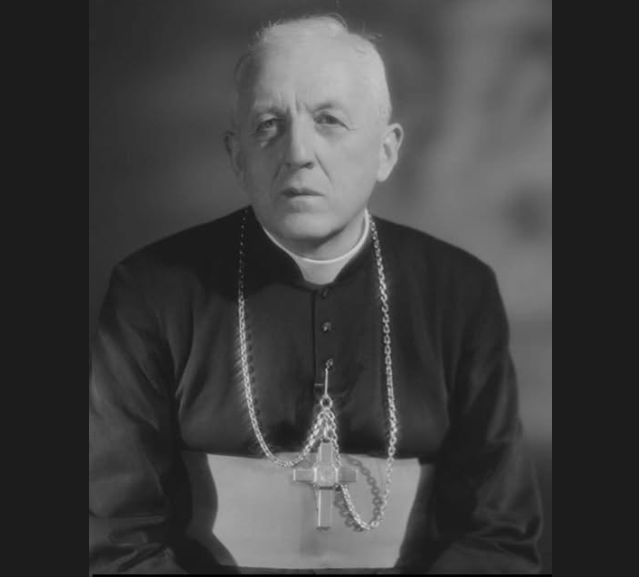
Quote:
He wrote one sentence before they took him. Then disappeared for 15 years. Cardinal József Mindszenty stood at the door of his palace in Esztergom, Hungary. December 26, 1948. The day after Christmas. Secret police cars circled outside. He was the highest Catholic official in Hungary. A Prince of the Church. And he knew exactly what was coming.
Before opening the door, he wrote a note and left it on his desk. *”If you hear that I have confessed or resigned, do not believe it. It will be the result of human frailty.”* Then he put on his simplest bishop’s robe, slipped a picture of Jesus wearing the crown of thorns into his pocket, and said goodbye to his elderly mother. They took him into the night.
For 39 days, they tortured him in a basement at 60 Andrássy Street in Budapest — one of the most notorious buildings in 20th century Europe. They beat him. Drugged him. Starved him. Kept him awake until his mind broke. He signed confessions to crimes he never committed. On February 3, 1949, they put him on trial. Five days later — life in prison.
The world erupted. President Truman called it infamous. Churchill condemned it. The Pope excommunicated everyone involved. Mindszenty heard none of it. He was in solitary confinement.
Seven years passed. Then on October 23, 1956, Hungary rose up against Soviet occupation. Students marched. Workers joined. Soldiers defected. The communist government collapsed. Revolutionaries reached Mindszenty’s prison after nearly eight years. He was driven to Budapest, gave a radio address, and praised the uprising. Hungary was going to be free. It lasted three days.
On November 4, 1956, Soviet tanks rolled into Budapest. They crushed the revolution, killed 2,500 people, and forced 200,000 to flee the country. Mindszenty ran to the US Embassy and asked for asylum. The Americans said yes. He walked through the doors — and would not walk out again for 15 years.
His room was a converted office. No windows that opened. A bed. An altar. A corner for prayer. He couldn’t step into the courtyard. Couldn’t be seen from the street. Outside, every single day, a secret police car sat waiting — three plainclothes officers watching the door, waiting for him to step outside.
He said Mass every morning. Wrote his memoirs in secret. Paced the same hallways. Years passed. 1960. 1965. 1970. He was still there. Popes changed. Presidents changed. The world changed. He stayed in his room. Then came the betrayal.
The new Pope, Paul VI, wanted peace with the communist world. Mindszenty was in the way — a living, breathing accusation against the regime. In 1971, the Vatican ordered him to leave. To step aside. So the Church could normalise relations with the men who had broken his body. Mindszenty understood. He wrote back: “I accept what will be perhaps the heaviest cross of my life.”
On September 28, 1971 — after **5,475 days** — he walked out of the embassy. He put on a black fedora. Got into a car. Was driven 100 miles to Vienna. As the car crossed the border, he removed the hat. Underneath was his red Cardinal’s biretta. He wanted Hungary to see who was leaving.
He never returned. In 1974, the Vatican stripped his titles. He had not resigned — he was being pushed out. Mindszenty called it a betrayal and published his memoirs. Six months later, he was dead. He died in Vienna on May 6, 1975, at the age of 83. He had asked that his body not return to Hungary “until the last Soviet soldier has left.”
The Soviets left Hungary in 1991. That same year, Mindszenty’s body was flown home and buried in the basilica at Esztergom — where he had once served as Archbishop. He outlived the regime. Just not in his own body.
This was a man who fought the Nazis — and was arrested. Who fought the communists — and was tortured for 39 days and sentenced to life in prison. Who was freed for three days during a revolution, then watched Soviet tanks crush it. Who lived in a single room in a foreign embassy, in his own capital city, unable to open a window or walk outside, watched by secret police every single day for 15 years. Then told to leave by his own Pope.
He died in exile. Stripped of his titles. Never seeing home again.
Bishop Fulton Sheen called him the “Dry Martyr” — martyred without being killed. Slowly crushed by isolation, torture, and betrayal. But here is the thing. Communism tried to break him. *He outlasted it.* His own Church tried to sideline him. *He outlasted that too.* Sixteen years after he died, his body came home in triumph.
Cardinal József Mindszenty — fought Nazis, fought communists, tortured, imprisoned, trapped, exiled, stripped by his own Pope — died without ever seeing home again. *But he won.* Because tyranny falls. And the truth doesn’t.
Once again we see how the Papacy and Curia play politics rather than leading the church. Paul VI stripped him of all his titles. However, the beatification and eventual canonization of Cardinal Mindszenty has been on the Hungarian Catholic Church’s agenda ever since communism fell in 1989, and the 2005–2013 pontificate of Pope Benedict XVI was seen by many analysts as an excellent opportunity to achieve both, as the Pope had commented favourably on Mindszenty’s calling and legacy.
The cause for the cardinal’s beatification opened on 15 June 1993; Mindszenty became titled as a Servant of God after the Congregation for the Causes of Saints (CCS) assented to introducing the cause in a decree nihil obstat (“no objection”).
The diocesan process (collecting his spiritual writings and collecting witness interrogatories to attest to his reputation for holiness) opened in Esztergom on 19 March 1994 and closed 17 October 1996; the CCS validated the process as having complied with their regulations in Rome on 8 November 1999. In 2012, the Hungarian Bishops’ Conference reaffirmed its support for continuing the late cardinal’s cause for beatification. Theologians voiced their approval for the cause on 14 June 2018.
Pope Francis declared Mindszenty venerable on 12 February 2019. The investigation continues towards Beatification.